Build daily in-app habits that drive 3–5× retention →
Stop losing users and revenue to Big Tech. Own your social graph with Social+ SDK.
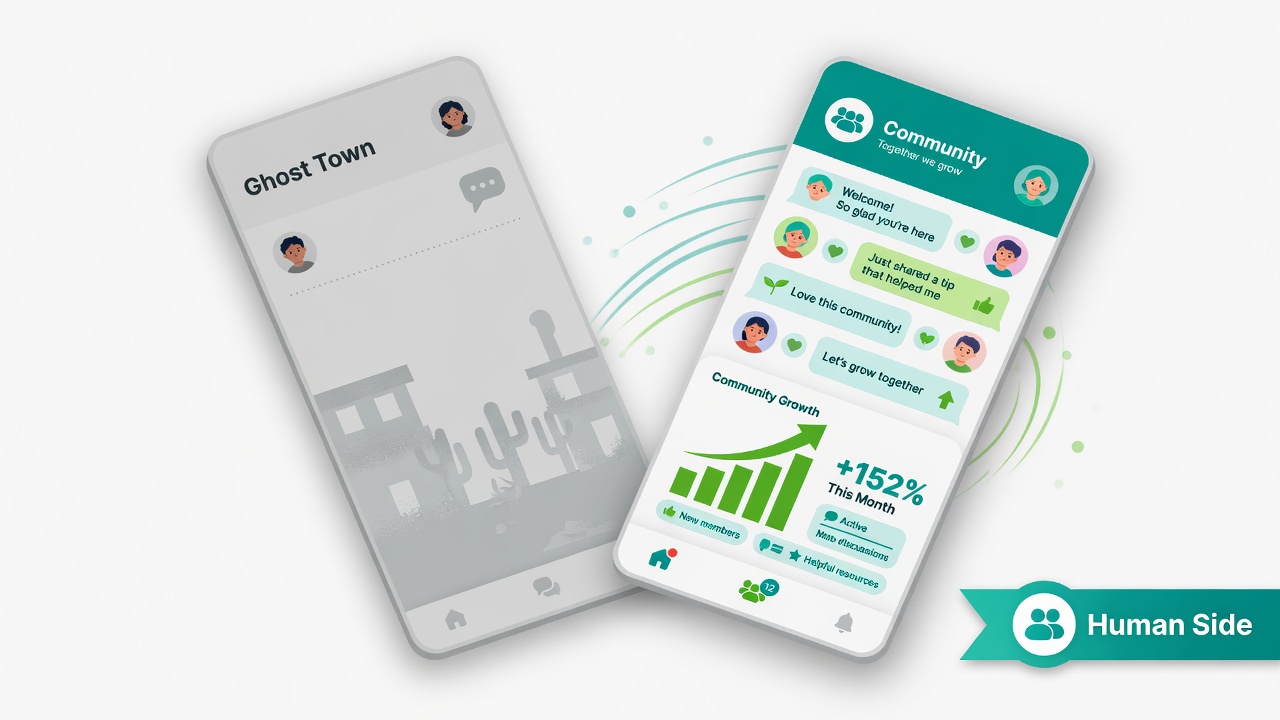
You launch your app with a shiny new community feature. Users sign up. Notifications go out. Then… nothing.
Posts sit unanswered. The feed stays empty. People open the tab once, see silence, and never return. This is the ghost town trap. It feels personal. It feels like a failure of growth or product. But it is usually something deeper.
The cold start problem is not just a numbers game. It is a human psychology problem. And most teams underestimate how powerful those human limitations really are.
Here is what that means for you. You can have the best SDK, the most beautiful UI kit, and perfect push notifications. If people will not post first, or will not stay when the room feels empty, none of it matters.
This post explores the real reasons communities stay dead. We will look at the chicken-and-egg mechanics, the quiet psychological barriers, and the practical ways successful teams have escaped the trap.
No hype. Just what actually works in real life.
The ghost town trap is simple to describe but brutal to escape. You need activity to attract users. You need users to create activity. When neither exists at the start, the space stays empty. Users arrive, feel the emptiness, and leave. The emptiness then becomes self-reinforcing.
This is the classic cold start problem applied to in-app communities. It shows up in every vertical. Gaming apps launch guilds that never fill. Fintech apps add social feeds that stay silent. Education platforms create class forums where the first student posts into a void.
The trap is not unique to apps. Marketplaces, social networks, and even internal tools face it. What makes in-app communities especially hard is that users already have a reason to open your app. They just do not have a reason to talk inside it yet. The bar feels higher because the surrounding experience already works.
Many teams treat this as a growth or notification problem. They blast more pushes or run expensive acquisition. That usually makes the silence louder. The real issue sits one layer deeper.
Every community builder eventually hits the chicken-and-egg wall. Content needs an audience. An audience needs content. Interactions need people willing to interact first. Without one side, the other never starts.
In two-sided marketplaces this is obvious. Buyers will not come without sellers. Sellers will not list without buyers. In communities the sides are more subtle but just as real. You need posters and you need readers who eventually become posters. You need people who feel seen and people willing to do the seeing.
The problem compounds in in-app settings. Your users already have a job to do inside the app. They opened it to trade, learn, play, or manage money. Asking them to also build the social layer feels like extra work with uncertain payoff. That uncertainty is the killer.
Traditional growth tactics often ignore this. You can buy users. You cannot buy the feeling that posting is safe or worthwhile. That feeling only comes from seeing others already doing it successfully.
Here is the part most technical teams miss. The cold start problem is not primarily a technical or distribution challenge. It is a human motivation challenge. People are wired in ways that make first participation feel risky.
Consider the well-documented 90-9-1 rule from participation research. In most online communities, roughly 90 percent of users lurk without ever posting. Nine percent contribute occasionally.
Only one percent create the vast majority of content. This is not laziness. It is rational behavior shaped by social dynamics.
Why do the 90 percent stay silent? Fear of judgment sits at the top. Posting first means risking looking foolish, off-topic, or too eager. There is no social proof yet that this space rewards vulnerability or questions. The cost of a bad first post feels high. The benefit feels abstract.
Another barrier is effort versus reward. Writing a thoughtful post takes time. In an empty community the expected response is zero. People unconsciously calculate that the effort will be wasted. They stay quiet and check back later. Later never comes.
Status and belonging also play roles. People want to contribute where their contribution will be valued by peers they respect. In a brand-new space that peer group does not yet exist in visible form. The early posters are performing without an audience. Most humans are not wired to enjoy that.
These are not character flaws. They are predictable responses to missing social cues. Any strategy that ignores them will keep producing ghost towns no matter how good the technology underneath becomes.
Further reading: Nielsen Norman Group on participation inequality
Reddit’s early days offer a classic case. The founders manually created hundreds of fake accounts and seeded content to make the site feel alive. Without that deliberate seeding, the real users who arrived would have seen emptiness and left. The “fake it until you make it” approach worked because it solved the human perception problem first.
Many Web3 projects in recent years learned the same lesson the hard way. Discord servers and token-gated communities launched with heavy hype and token incentives. When the hype faded, the rooms went quiet. Members had joined for financial upside or status signaling, not genuine connection. Without ongoing human reasons to stay, the spaces became expensive ghost towns.
Closer to in-app experiences, early versions of many gaming social features show the pattern. Guilds or clans launch with great UI and rewards for joining. The first wave of players arrives, looks around, sees no ongoing conversations or events, and treats the feature as decorative rather than social. Activity never compounds.
Successful cases usually share one pattern. They did not wait for organic critical mass. They engineered the first visible activity deliberately, then made it easy and rewarding for real users to add the next layer. The technology mattered less than the careful human choreography around it.
The phrase “build it and they will come” is comforting. It is also one of the fastest ways to create a ghost town. It assumes that a good product or feature is enough to trigger participation. Human behavior does not work that way.
People do not automatically become contributors just because the channel exists. They become contributors when the environment reduces perceived risk and increases perceived reward. That environment must be created, not assumed.
Many teams also fall into the “more users will fix it” trap. They focus on acquisition while the community remains silent. New users arrive, experience the same emptiness, and churn faster. The metric dashboards look healthy on signups and terrible on retention and engagement depth. The root cause stays unaddressed.
Another common mistake is over-relying on extrinsic rewards early. Badges, points, or tokens can bring bodies into the room. They rarely turn those bodies into engaged community members. When the rewards stop feeling novel, the participation drops. The underlying social motivation was never built.
Escaping the trap requires treating the early community as a carefully designed social experience, not just a feature. Here are approaches that consistently help teams move past the cold start.
Instead of launching a giant open community, begin with small, dense groups that already have reasons to talk. A cohort of new users onboarding together. A beta group of power users. A geographic or interest-based micro-community inside the larger app. These small networks can reach critical mass quickly. Once they feel alive, you can expand outward while preserving the sense of activity.
This does not mean fake engagement that feels deceptive. It means creating starter content, conversation prompts, or example interactions that real users can react to or build upon. The goal is social proof that “people like me are already here and it is safe and worthwhile to join in.” Done well, this lowers the psychological barrier for the first real posts.
Most interfaces optimize for the power users who will post anyway. Instead, reduce friction for low-stakes participation. Quick reactions, simple polls, “me too” buttons, and low-effort ways to signal presence all help lurkers feel part of something without the risk of a full post. Over time, some of those low-stakes actions turn into higher-stakes ones.
Notifications and activity feeds can create the perception of an audience even when the absolute numbers are still small. A new user who posts and immediately sees relevant replies or reactions learns that contribution is noticed. That learning is more powerful than any incentive.
Identify the small percentage of users most likely to become consistent contributors. Give them extra attention, easier tools, or recognition. Their visible activity then pulls others in. This is more effective than trying to activate the entire user base at once.
Technology cannot replace the human dynamics, but it can reduce friction and amplify the right signals. Activity feeds that surface relevant recent interactions help new users see that the space is alive. Real-time presence indicators show that other people are currently around. Easy-to-use moderation tools reduce fear that toxic behavior will go unchecked.
Thoughtful onboarding that guides a user to a relevant small group or first action lowers the “where do I even start” barrier.
The most effective implementations treat these features as social scaffolding rather than pure utility. The goal is to make the first positive interaction feel inevitable rather than optional.
Vanity metrics like total registered community members hide the ghost town problem. Track leading indicators instead. Percentage of users who view content versus those who contribute anything, even a reaction. Time from join to first interaction. Percentage of posts that receive at least one reply within the first hour. These signals tell you whether the social fabric is forming or whether you are still in silent mode.
When these early signals stay flat, it is a sign that the human barriers have not yet been addressed, no matter how many users you have acquired.
Teams that push through the cold start phase often discover that the community becomes one of the strongest retention and differentiation moats they have. Users who have posted, received replies, and formed loose connections inside the app are far less likely to churn. They bring others with them. They provide feedback and content that no central team could create at scale.
The early investment in understanding human limitations and designing around them pays dividends for years. The apps that treat community as an afterthought keep fighting the same empty-room problem at every growth stage. The ones that solve it early turn users into participants and participants into advocates.
Further reading: Andrew Chen on solving cold start
Some approaches actively deepen the trap. Over-moderation or heavy-handed rules early on signal that posting is risky. Flooding new users with too many notifications creates noise without context. Launching with purely promotional content from the brand makes the space feel like marketing rather than belonging. Treating all users the same instead of nurturing the small core that will model behavior wastes the limited early energy.
Each of these mistakes usually comes from optimizing for scale or control instead of for the fragile social dynamics of the first few hundred interactions.
It varies widely by vertical and how deliberately you seed early activity. Many teams see meaningful organic momentum between 8 and 16 weeks when they focus on small dense groups and visible early interactions. Without that focus, the phase can drag on indefinitely or never end.
Yes. Many valuable communities have high lurker ratios. The goal is not to turn every user into a poster. It is to make sure the visible activity is high enough quality and density that lurkers still feel they are part of something worthwhile and that occasional posters have an easy on-ramp.
AI can help with moderation, content suggestions, and personalization at scale. It cannot create genuine social proof or belonging. Those still require real human signals early on. Automation works best as support for human-led early activity, not as a replacement for it.
The core human barriers remain similar, but the incentives and context differ. In internal or B2B settings, status, job relevance, and existing relationships can lower some barriers. At the same time, fear of looking uninformed in front of colleagues can raise them. The same principles of small starts, visible early activity, and low-friction participation still apply.
Start by auditing your current or planned community space through a human lens. Where is the first post likely to happen? What makes that post feel safe or worthwhile? What will a new user see in the first 30 seconds that signals “this place has life and I belong here”?
Then pick one small atomic group or cohort and deliberately engineer the first layer of visible, positive activity. Measure the signals that actually indicate social fabric is forming. Iterate from there.
The ghost town trap is not inevitable. It is the predictable result of ignoring human psychology at the start.
Teams that respect those human limitations and design for them early give themselves a real chance at the compounding benefits that only thriving in-app communities can deliver.

Stop losing users and revenue to Big Tech. Own your social graph with Social+ SDK.
Portfolio sharing, group investing and live trading rooms
Study groups, peer leaderboards and live classrooms
Group trip planning and real-time shared experiences
Live shopping, group buys and influencer feeds
Challenges, kudos and community workout streaks
Guilds, leaderboards and watch parties
Fan communities, fantasy leagues and live match chats
Secure care-team chat, patient support circles and family hubs
Live voice rooms, creator AMAs and podcast communities