Build daily in-app habits that drive 3–5× retention →
Stop losing users and revenue to Big Tech. Own your social graph with Social+ SDK.
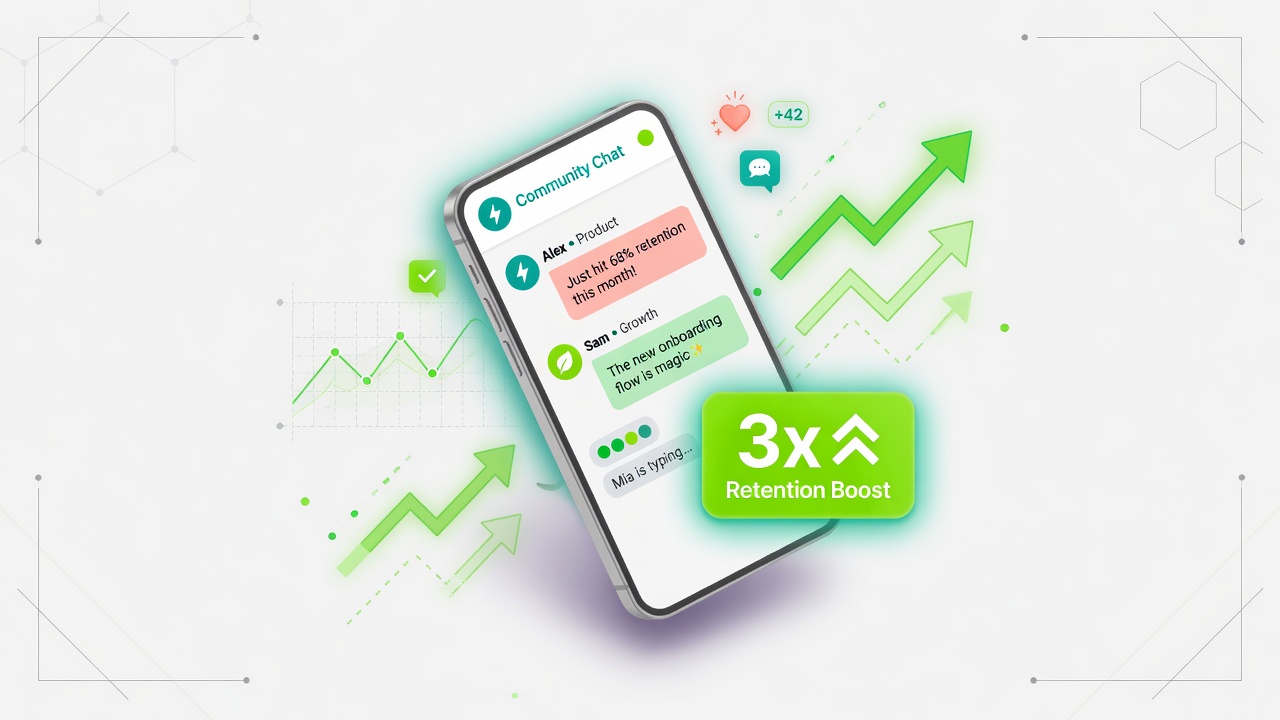
Imagine your users opening your app once and never returning. Sound familiar? Many apps face this exact problem. Day-30 retention often hovers around 4-7% across industries. Yet some apps defy the odds and keep users coming back daily, month after month.
The secret? Real-time chat and social features. Adding seamless in-app messaging creates connection, community, and habit. Users don't just use your app—they talk, share, and build relationships inside it.
Here’s what that means for you. A well-implemented real-time chat SDK can boost retention by 3x or more. You’ll see higher engagement, lower churn, and stronger lifetime value. Ready to make it happen?
A real-time chat SDK is a ready-made toolkit that lets developers add instant messaging to apps without building everything from scratch. It handles WebSockets, message delivery, presence detection, and more behind the scenes.
Instead of managing servers, scaling infrastructure, or debugging connection issues yourself, you integrate the SDK. You get features like one-on-one chat, group rooms, file sharing, and typing indicators right away.
Think of it as outsourcing the heavy lifting. You focus on your core product while the SDK powers smooth, reliable conversations. This approach saves months of development time and reduces costs dramatically.
Modern real-time chat SDKs support iOS, Android, Flutter, React Native, and web. They scale to millions of users and include built-in moderation, analytics, and security tools. For deeper insights into related social features, check out how personalized activity feeds complement chat experiences.
Data tells a clear story. Apps with strong social features see significantly higher retention. In-app messaging turns passive users into active community members who return regularly.
Studies show personalized in-app communication can increase retention rates by 3x in the first 28 days. Users who engage in chat often stick around because they form real connections. According to recent benchmarks, live chat features contribute to stronger long-term user loyalty.
One analysis found that daily+ messaging users had retention rates up to 820% higher than those with no interaction. Even weekly engagement delivered substantial lifts. A 2026 app retention guide highlights how real-time features help beat industry averages across platforms.
Here’s why it works. Chat creates habit loops. Users check messages, reply to friends, join discussions, and come back tomorrow. It combats the “ghost town” effect where apps feel empty and lonely. Explore more on avoiding this pitfall in the ghost town trap guide.
Real-time messaging does more than let users talk. It creates emotional investment. When users message friends or join group discussions, your app becomes part of their social life.
Typing indicators and read receipts add immediacy. Users feel present and connected. Reactions and rich media make conversations fun and expressive.
Imagine a fitness app where members cheer each other on in live chat during challenges. Or a shopping app with buyer-seller direct messaging. These experiences keep users returning.
Engagement compounds. More messages lead to more notifications, which bring users back. Over time, this builds powerful network effects that are hard for competitors to copy. Pairing chat with notifications is covered in detail in reducing churn with social proof tactics.
Not all SDKs are created equal. Look for scalability, ease of integration, and rich features. Top options support cross-platform development and include UI kits to speed up implementation.
Key factors to evaluate: message history retention, moderation tools, analytics dashboards, and compliance with GDPR or COPPA. Also check pricing models—some charge by monthly active users.
Consider your tech stack. Flutter or React Native developers benefit from unified codebases. Ensure the SDK offers excellent documentation and sample code.
Security matters too. Look for end-to-end encryption options and robust spam protection. Reliable uptime and low latency are non-negotiable for great user experiences. Learn more about secure implementations in security best practices for real-time chat and social SDKs.
Compare features like threaded replies, voice messages, file uploads, and AI-powered moderation. The best SDKs evolve quickly with new capabilities each year.
Ready to add messaging? Follow this practical guide. Most integrations take days rather than weeks when using a quality SDK.
Step 1: Define your chat needs. Decide on one-on-one, group, or channel-based messaging. Identify use cases specific to your app vertical.
Step 2: Set up your project. Install the SDK via npm, CocoaPods, Gradle, or pub.dev depending on your platform. Initialize the client with your API keys.
Step 3: Handle authentication. Connect user identities securely. Use your existing auth system to map users to chat profiles.
Step 4: Build the UI. Use provided UI kits or custom components. Start simple with a basic message list and input field.
Step 5: Add real-time listeners. Subscribe to message events, presence changes, and typing indicators for live updates. Track performance using KPIs every social SDK implementation should track.
iOS developers can leverage SwiftUI for modern interfaces. Android teams benefit from Jetpack Compose compatibility in newer SDKs.
Flutter offers true cross-platform consistency. One codebase serves iOS, Android, web, and even desktop. React Native shines when sharing logic with web versions.
Test thoroughly on real devices. Network conditions vary widely—simulate poor connections during development.
Optimize for battery and data usage. Efficient SDKs minimize background activity while keeping messages flowing.
Here’s a quick tip: Start with a minimum viable chat feature. Launch fast, gather feedback, then iterate with advanced capabilities like reactions or polls.
Great chat experiences feel natural and helpful. Avoid overwhelming users with too many notifications early on. A detailed in-app chat planning guide offers excellent use cases and strategies.
Personalize where possible. Show relevant group suggestions based on user interests or behavior.
Implement smart moderation from day one. AI tools can flag toxic content automatically while preserving free expression.
Encourage healthy conversations with subtle nudges—like welcome messages in new groups or daily discussion prompts.
Track key metrics: message volume, session duration in chat, and return frequency. Use insights to refine features continuously.
Many apps have transformed retention with chat. Fitness platforms see users logging workouts and celebrating together in group rooms.
Gaming communities thrive with in-game voice and text chat, reducing churn during difficult levels. Education apps use messaging for peer study groups.
Fintech and shopping apps enable direct buyer-seller communication, building trust and speeding transactions. Results often include doubled engagement metrics.
One common pattern: apps that combine chat with activity feeds see the strongest lifts. Users discover conversations through feeds and dive deeper into messaging.
Vertical-specific tweaks matter. Healthcare apps prioritize privacy and compliance. Travel apps focus on trip planning groups. Recent analyses confirm real-time features help combat retention challenges across sectors.
Once basic messaging works, layer on richer capabilities. Threaded replies keep discussions organized in busy groups.
Voice and video messages add personality. File and image sharing turns chat into a collaboration hub.
Reactions and emojis make interactions fun and quick. Online presence shows who’s available right now.
AI features like smart replies or translation open your app to global audiences. Push notifications for new messages bring users back instantly.
Integrate chat with other social features for maximum impact. Link it to personalized activity feeds or live events.
Scaling real-time connections can strain resources. Choose an SDK with proven infrastructure at enterprise levels.
Offline support is crucial. Users expect messages to sync when they regain connectivity.
Security and privacy concerns arise with user-generated content. Implement end-to-end options where needed and clear data policies.
Cross-device consistency matters. Ensure conversations flow seamlessly between phone, tablet, and web.
Testing real-time features requires special attention. Simulate multiple users and varying network conditions.
Track the right metrics to prove ROI. Monitor day-1, day-7, and day-30 retention specifically for users who engage in chat versus those who don’t.
Message send/receive rates, average session time in chat, and group participation numbers reveal engagement depth.
Churn reduction and lifetime value increases are ultimate goals. Compare cohorts before and after adding messaging.
Use built-in analytics from your SDK or integrate with tools like Mixpanel or Amplitude for deeper insights.
Regular A/B tests help optimize. Try different welcome flows or notification strategies and measure impact.
Protect user data rigorously. Use strong authentication and encrypt sensitive messages where appropriate.
Implement content moderation to prevent abuse. Combine automated filters with human review for edge cases.
Stay compliant with regulations like GDPR for data rights and COPPA for younger users.
Regular security audits and updates keep your implementation safe as threats evolve.
Transparent privacy controls build user trust. Let users manage who sees their messages and activity.
AI will play a bigger role. Expect smarter moderation, context-aware replies, and personalized conversation starters.
Multimodal messaging combining text, voice, video, and AR elements is rising. Immersive experiences will differentiate top apps.
Deeper integration with other social layers—like activity feeds and live rooms—will create unified community hubs inside apps.
Edge computing may reduce latency even further for global audiences. Privacy-preserving technologies will gain importance.
Stay ahead by choosing a forward-looking SDK that releases frequent updates and new capabilities. Industry reports from 2026 emphasize the growing role of real-time tools in retention strategies.
Adding in-app messaging doesn’t have to be complex. Start small, focus on core value for your users, and iterate based on real feedback.
Explore how chat complements other social features in your app. Combined implementations often deliver the biggest retention wins.
Your users want connection. Give them a delightful way to communicate inside your app, and watch retention climb.
Take the first step. Evaluate SDK options, plan your use cases, and begin integration. The payoff in engagement and loyalty will be worth it.
Many apps see measurable lifts within weeks of launch. Full 3x effects often appear after users build habits over 30-90 days. Consistent engagement features accelerate results.
Most modern SDKs handle backend infrastructure for you. You focus on client-side integration and UI. This dramatically reduces required resources compared to building from scratch.
Leading SDKs offer enterprise-grade security including encryption, moderation, and compliance tools. Choose providers with strong track records and review their security documentation carefully.
Yes. Cross-platform SDKs and UI kits make consistent experiences possible with shared code. Test thoroughly to ensure smooth performance on every platform.
In-app messaging powered by a solid real-time chat SDK is one of the highest-ROI features you can add. It turns solitary app usage into social experiences users love and return to.
Follow the steps outlined here. Choose features that match your users’ needs. Measure results and keep improving.
The apps winning in 2026 and beyond will feel alive with conversation and community. Don’t let your users feel alone—give them ways to connect right inside your product.
Start building better retention with Social+ SDK. Your future metrics will thank you.

Stop losing users and revenue to Big Tech. Own your social graph with Social+ SDK.
Portfolio sharing, group investing and live trading rooms
Study groups, peer leaderboards and live classrooms
Group trip planning and real-time shared experiences
Live shopping, group buys and influencer feeds
Challenges, kudos and community workout streaks
Guilds, leaderboards and watch parties
Fan communities, fantasy leagues and live match chats
Secure care-team chat, patient support circles and family hubs
Live voice rooms, creator AMAs and podcast communities