Build daily in-app habits that drive 3–5× retention →
Stop losing users and revenue to Big Tech. Own your social graph with Social+ SDK.
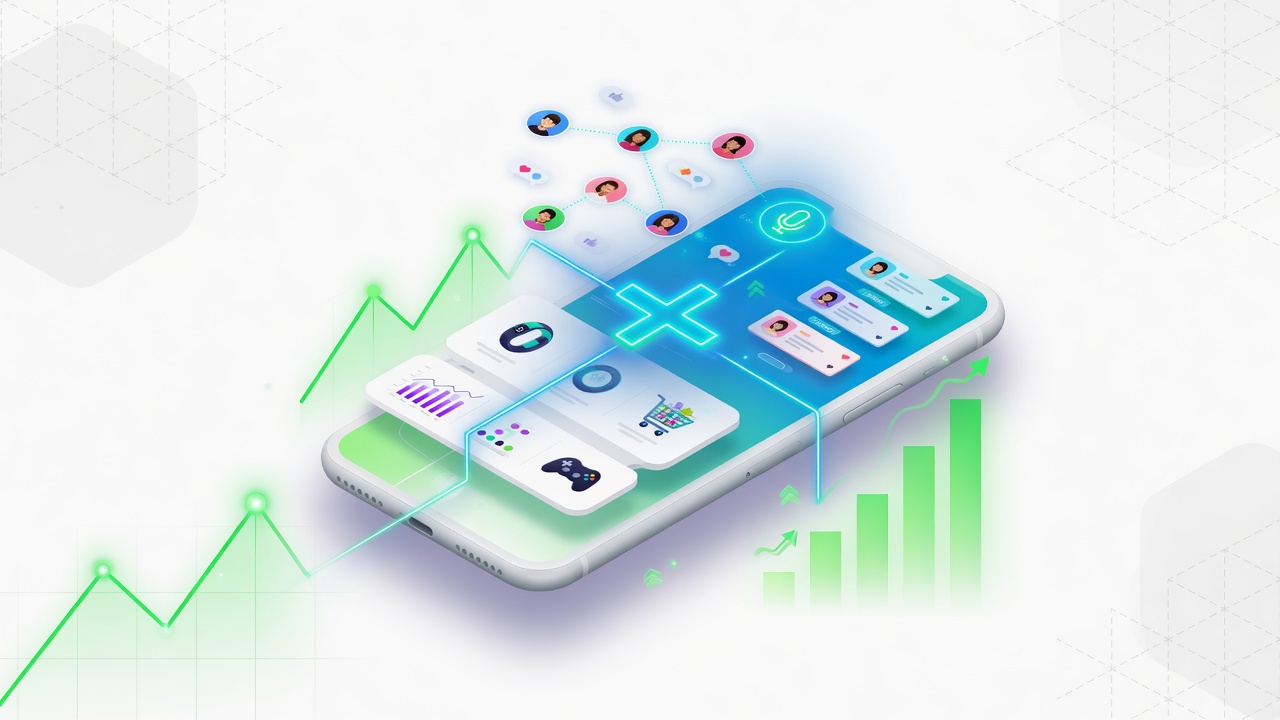
Social+ has become one of the most powerful descriptive terms in tech today. It refers to any product or app that layers deep social and community features directly into a core category experience.
Think of it as “social plus” something specific. Social+ Education. Social+ Shopping. Social+ Finance. The social element isn’t bolted on. It becomes inseparable from the main function.
This concept gained major traction after A16Z's D'Arcy Coolican published his landmark analysis back in December 2020.
The team at socialplus.com saw it coming much sooner — immersed in social growth, human psychology, and algorithms since 2010, we witnessed Big Tech repeatedly tweak feeds in ways that prioritized corporate greed over genuine user connection.. In 2022, co-founder Adam Moore stated, “Recent news has suggested that changes on YouTube and Instagram will lead to their decline,” reinforcing our long-held belief in the power of true owned communities.
Sendbird’s deep dive into Social+ apps built directly on that foundation. They showed how these experiences create owned communities that keep users coming back for both function and connection.
You see the pattern everywhere now. Apps that once felt single-player now thrive when they turn multiplayer. Users don’t just complete tasks. They share, compete, encourage, and belong.
The term Social+ captures this exact shift. It describes the winning formula for modern apps across every vertical.
Here’s what that means for you as a builder or product leader. Social+ isn’t a feature checklist. It’s a complete redesign of how your app delivers value.
The term gained mainstream traction through A16Z’s "Social Strikes back" content-series. They defined Social+ companies as those building integrated social experiences around a specific category.
Key conditions they outlined: a proprietary social graph purpose-built for the product, deep integration where social is not optional, and genuine peer-to-peer engagement.
Sendbird, among others, expanded this idea in their 2023 analysis of Social+ apps. They emphasized the dual layers — transaction for the core job and interaction for emotional needs.
Together these pieces created a shared language. Founders, investors, and developers now use “Social+” to describe the next evolution beyond pure social networks.
Early examples proved the power. TikTok became Social+ music and crushed Spotify’s growth trajectory. Pinduoduo turned group buying into Social+ shopping and hit $100 billion market cap in record time.
Fortnite showed Social+ gaming could generate billions while single-player titles plateaued. The pattern repeated across audio, sports, and more.
Today the term appears in pitch decks, product roadmaps, and boardroom discussions. It signals a strategic choice to build community as a core competitive advantage.
A true Social+ app combines two layers that work in perfect harmony. The transaction layer handles the primary job — buy, learn, train, invest, play.
The interaction layer adds peer-to-peer connection — chat, share, compete, support, celebrate. Neither works as well without the other.
Unlike traditional social media (Facebook, Instagram, YouTube), Social+ apps own their community graph. Users connect inside the product, not on external platforms.
This ownership creates defensibility. Network effects compound inside your app rather than feeding someone else’s algorithm and bottom line.
Sendbird notes that Social+ products deliver inspiration, encouragement, status, and belonging alongside functional value. That combination creates sticky habits.
A16Z highlights the asymmetry. Social+ versions of products win on growth, engagement, retention, and long-term value.
You feel the difference as a user. The app stops feeling like a tool and starts feeling like a place where your people gather.
Builders who master this formula report dramatically better metrics. Session times climb. Retention curves flatten upward. Organic growth accelerates.
Users have grown tired of passive scrolling on big social platforms. They crave meaningful connection tied to shared goals and interests.
Privacy concerns and mental health awareness push people toward smaller, purpose-driven communities. Social+ apps deliver exactly that.
Post-pandemic behavior accelerated the shift. People discovered they could learn, train, invest, and shop while staying socially connected.
Developers now expect tools that make Social+ features easy to add. The demand for real-time chat, activity feeds, and live rooms has never been higher.
Investors screen for Social+ potential in every deal. They know single-player apps face steep acquisition costs and high churn.
The economic case is clear. Social+ layers turn users into advocates. Referrals, user-generated content, and viral loops reduce marketing spend.
Every category is heading this direction. No vertical remains immune. The question is no longer if, but how fast your app becomes Social+.
These numbers come directly from real Social+ implementations tracked by industry leaders.
Real-time infrastructure forms the foundation. WebSockets and low-latency messaging keep conversations flowing without delay.
Scalable backend systems handle millions of concurrent users. Auto-scaling prevents outages during viral moments or live events.
Customizable UI components let teams match brand identity perfectly. Developers avoid rebuilding chat wheels from scratch.
Moderation tools combine AI with human oversight. Safe communities grow faster because users trust the space.
Analytics dashboards reveal engagement patterns. Teams optimize features based on what actually drives retention.
Cross-platform support ensures consistency. iOS, Android, web, and Flutter users experience identical social layers.
Security and compliance come built-in. GDPR, COPPA, and enterprise standards protect user data from day one.
Learn advanced implementation tactics in our security best practices guide.
Start by mapping your core transaction layer. Identify where users already want to connect around that activity.
Choose the right social features. Activity feeds work for content sharing. Live rooms suit real-time events. Groups build long-term belonging.
Integrate peer-to-peer engagement early. Make social actions feel natural, not forced. One-tap invites and reactions lower friction.
Test with a small cohort. Gather feedback on what feels authentic versus gimmicky. Iterate quickly before full rollout.
Measure the right metrics from launch. Track session duration, group join rates, message volume, and day-30 retention.
Scale thoughtfully. Monitor infrastructure costs and moderation workload as community size grows.
Review detailed KPIs in the complete measuring success KPIs guide.
Document everything. Successful Social+ teams treat community guidelines and feature roadmaps as living products.
Internal teams often reference our social SDK learning hub for proven patterns and code examples.
Stay flexible. User behavior evolves. The best Social+ apps continuously refine the balance between function and interaction.
Retention improves dramatically. Users return for their community even when core tasks feel routine.
Engagement deepens. Session lengths increase as social features turn passive moments into active conversations.
Acquisition costs drop. Organic invites and shares create powerful viral loops.
Defensibility strengthens. A proprietary social graph becomes extremely hard for competitors to replicate.
Monetization expands. Creator tools, premium groups, sponsored events, and in-app economies open new revenue streams.
Data richness explodes. You learn exactly what motivates your users through their social interactions.
Brand loyalty skyrockets. Emotional connections make users advocates who defend and promote your app.
Industry data consistently shows Social+ apps outperform single-player versions by wide margins on every key metric.
Users with strong social ties stay 3–5× longer.
Peer invites reduce CAC dramatically.
150% longer sessions reported across implementations.
Network effects create lasting moats.
These gains compound over time. Early Social+ movers capture category leadership before others catch up.
| Traditional Social | ||
| Purpose | Tied to specific category activity | General scrolling and broadcasting |
| Ownership | Proprietary graph inside your app | Relies on external platforms |
| Engagement Type | Peer-to-peer and functional | One-way or algorithmic |
| Retention Driver | Community belonging + utility | Fear of missing out |
| Monetization | Integrated with core value | Ads and attention economy |
The contrast explains why Social+ apps feel more meaningful to users. They solve real problems while fulfilling social needs simultaneously.
Balancing transaction and interaction layers takes careful design. Too much social can distract from core tasks.
Moderation workload grows with community size. Strong AI plus clear guidelines prevent toxicity without stifling conversation.
Technical scaling surprises many teams. Real-time systems must handle sudden usage spikes gracefully.
User onboarding to social features requires thoughtful nudges. Not everyone jumps into groups immediately.
Privacy expectations vary by vertical. Healthcare and education demand stricter controls than gaming.
Measuring true community health goes beyond vanity metrics. Focus on meaningful interactions and retention impact.
Successful teams tackle these issues systematically. They treat Social+ as an ongoing product discipline rather than a one-time launch.
AI will supercharge matching and moderation. Intelligent systems suggest perfect groups and flag issues proactively.
Voice and spatial audio experiences will expand. Live rooms feel more natural when sound feels three-dimensional.
Cross-device continuity becomes table stakes. Start a discussion on mobile and continue seamlessly on desktop.
Gamification elements reward positive community behavior. Streaks, badges, and shared goals keep engagement high.
Vertical-specific Social+ templates will emerge. Finance, fitness, and education each develop unique best practices.
The A16Z prediction holds true. Every major category will eventually have its dominant Social+ winner.
Teams that start building now gain first-mover advantages. The window for category leadership is closing fast in many verticals.
Social+ describes apps that inseparably combine a core functional transaction layer with peer-to-peer community interaction. The term was popularized by A16Z and further detailed by platforms like Sendbird.
Traditional social media focuses on broad broadcasting and scrolling. Social+ ties social features directly to a specific activity or category, creating owned communities inside purposeful apps.
Fintech, fitness, education, gaming, ecommerce, healthcare, and travel show the strongest results. Any category where users benefit from shared knowledge or mutual support sees major gains.
Session duration, day-30 retention, organic acquisition, and lifetime value show the biggest lifts. Community-driven apps consistently outperform single-player versions across the board.
Modern SDKs enable full integration in days or weeks rather than months. Pre-built components and clear documentation accelerate the journey significantly.
No. Enterprise, B2B, and internal tools also benefit when teams add collaboration layers. The principles apply anywhere human connection improves outcomes.
Audit your current product for natural social moments. Where do users already want to connect?
Define success metrics before you build. Decide which retention and engagement numbers matter most for your vertical.
Explore proven patterns in your industry. Learn from leaders who already cracked the Social+ code.
Start small with one high-impact feature. A simple activity feed or group chat can deliver quick wins.
Gather user feedback early and often. Authenticity matters more than flashy features.
Build for the long term. Social+ is a strategy, not a sprint. Commit to continuous community investment.
Check vertical-specific guides on gaming, fitness, or healthcare for tailored insights.
The future belongs to apps that understand humans need both utility and connection. Social+ gives you the blueprint.

Stop losing users and revenue to Big Tech. Own your social graph with Social+ SDK.
Guilds, leaderboards and watch parties
Portfolio sharing, group investing and live trading rooms
Study groups, peer leaderboards and live classrooms
Group trip planning and real-time shared experiences
Live shopping, group buys and influencer feeds
Challenges, kudos and community workout streaks
Fan communities, fantasy leagues and live match chats
Secure care-team chat, patient support circles and family hubs
Live voice rooms, creator AMAs and podcast communities
Social+ Examples Across Key Industries
Fintech shows the power clearest. Apps like Public and eToro let users invest while discussing trades and following top performers in real time.
Fitness moved from solo tracking to Social+ experiences. Strava built peer competition and kudos that keep runners and cyclists motivated daily.
Education platforms added live study groups and peer feedback. Students learn better when they can ask questions and celebrate wins together.
Gaming turned multiplayer into full Social+ ecosystems. Fortnite creators and players build lasting communities around custom experiences.
E-commerce platforms like Pinduoduo use group buying to make shopping social and cheaper. Users invite friends for shared discounts.
Healthcare apps create private support circles where patients share journeys safely. The emotional layer improves adherence and outcomes.
Travel apps connect travelers planning the same destinations. Tips, meetups, and shared itineraries turn solo trips into community adventures.
Explore how finance apps specifically implement Social+ features on our dedicated finance industry page.
See proven patterns in education at the education hub.