Build daily in-app habits that drive 3–5× retention →
Stop losing revenue to external apps. Own your social graph with Social+ SDK.
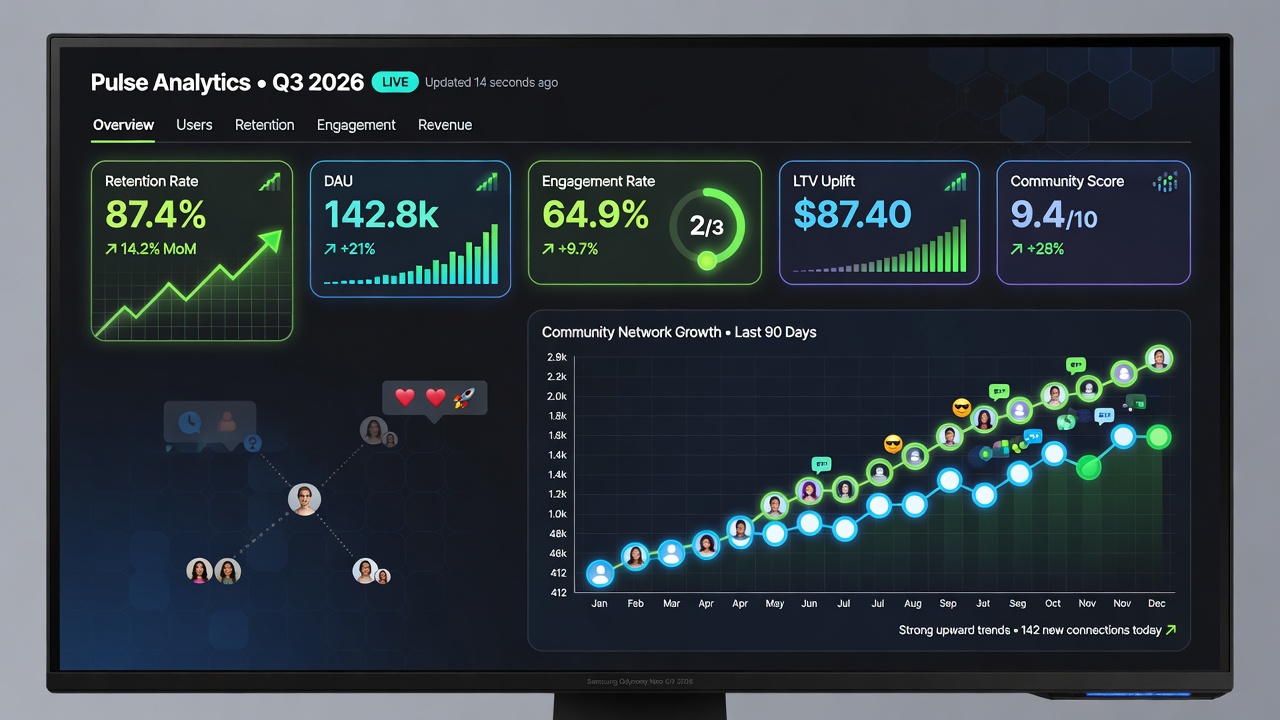
You integrate a powerful social SDK. Chat flows smoothly. Feeds load instantly. Rooms feel alive. Yet six weeks later users still churn at alarming rates.
The problem is rarely the SDK itself. It is the lack of clear measurement. Without the right KPIs you fly blind and cannot tell which features actually drive retention.
This in-depth guide changes that. You will discover every KPI worth tracking in 2026 for any social SDK implementation. You will learn exact formulas, 2026 benchmarks, real-world examples across verticals, and step-by-step setup instructions.
By the end you will have a complete playbook. You can prove social features deliver measurable business value. You can iterate faster and build communities that stick.
2026 brings tougher privacy rules, AI-driven expectations, and higher acquisition costs. Only teams armed with precise social data survive and thrive.
Imagine knowing exactly how many daily messages predict a user will stay for months. Or which live room format lifts day-30 retention by 40 percent. That level of insight turns your SDK investment into a predictable growth engine.
Developers and product leaders who master these metrics see three times faster iteration. Their apps become daily destinations instead of forgotten installs.
Let’s build your full KPI framework together. We start with the brutal 2026 retention reality and move through every layer of measurement you need.
Global mobile app retention continues its downward trend. Average day-one retention sits between 25 and 30 percent across categories.
By day seven that number often falls to around 13 percent. Day-30 retention hovers near 7 percent for most non-social apps according to multiple 2026 industry reports.
Android shows slightly lower figures with day-one at 21.1 percent dropping to 2.1 percent by day 30 in some datasets. iOS performs marginally better yet still struggles to keep users beyond the first week.
Social and gaming categories can achieve higher starting points yet still lose the majority without strong community layers. First impressions matter more than ever.
Adjust’s Mobile App Trends 2026 edition notes global installs grew 10 percent year-over-year while sessions only increased 7 percent. Users download fast but disengage even faster.
Privacy regulations and the death of third-party tracking make re-engagement harder. Acquisition costs keep rising while old attribution methods fail.
Investors now demand concrete proof of engagement and retention before committing capital. A social SDK without tracked KPIs looks like an expensive experiment rather than a strategic move.
Teams that implement proper measurement cut churn by up to 45 percent in the first three months after launch. The difference comes down to visibility.
You cannot improve what you do not measure. These benchmarks set the baseline. Your social SDK gives you the tools to beat them dramatically.
Explore more retention strategies in our learning hub for additional frameworks and case studies.
Traditional app KPIs focus on broad downloads, sessions, and crash rates. Social SDK KPIs zoom in on human connections and network effects that drive long-term loyalty.
You track not just opens but how many users join persistent groups or reply in threads. These interactions create emotional bonds that generic features cannot replicate.
Social data reveals the why behind retention. A single meaningful friend connection can keep a user active for months longer than any push notification alone.
Standard metrics miss the viral loops and compounding engagement that social infrastructure creates. You need granular event tracking for every message, reaction, room join, and feed interaction.
Adapty’s 2026 mobile app engagement metrics guide shows that social-enabled apps can reach 50-60 percent DAU/MAU stickiness ratios when community-specific KPIs receive weekly attention.
Your SDK events must feed directly into cohort analysis tools. Only then do you see the true causal impact of social features on user lifetime value.
Ignore this distinction and you risk optimizing the wrong elements. Focus on social-specific signals and you unlock unstoppable community growth.
Read the complete Adapty report for deeper engagement benchmarks at Adapty’s 2026 Engagement Metrics.
Day-one retention measures whether your first social touchpoint creates an immediate positive impression. Target 25-40 percent for apps with native community features.
Day-seven retention reveals early habit formation. Social features should push this metric above 20 percent by encouraging repeated interactions with friends or groups.
Day-30 retention proves lasting value. With proper social SDK implementation and measurement you can realistically aim for 38-68 percent once communities mature.
The basic formula for any retention rate is simple. Divide the number of users returning on that day by the original cohort size. Always segment by first social action taken.
Users who join even one live room on their first day retain significantly better at the 30-day mark than those who do not.
Set up automated alerts for any cohort that drops more than 10 percent below your historical baseline. Investigate root causes within 24 hours.
Always compare social-enabled cohorts against control groups that never see the new features. The difference often surprises teams and justifies further investment.
Review these retention KPIs every single week. Small changes to onboarding flows or notification timing can move day-30 numbers by double digits within a single sprint.
Many education platforms using collaborative chat SDKs report day-30 retention climbing from low teens to over 50 percent after consistent measurement and iteration.
Fintech apps with trading room features see similar patterns. Early social participation strongly predicts long-term retention across virtually every vertical.
Explore industry-specific retention patterns on our industries page to see how different sectors apply these core metrics.
Daily message volume per active user shows conversation health. Mature social communities often sustain three or more messages per user each day.
Reaction and reply depth measures emotional investment. Threads reaching five or more replies indicate genuine network effects taking hold.
Feed scroll-to-interact ratio reveals how relevant your personalized social content feels. Aim for at least 35 percent of scrolls ending in likes, shares, or comments.
Live room attendance rate tracks event-driven stickiness. Successful recurring rooms achieve 60 percent or higher repeat attendance week after week.
Story view completion percentage proves ephemeral content delivers value. Rates above 70 percent signal users actively crave daily updates from their network.
Cross-device activity sync rate ensures seamless experiences. Measure how often users continue conversations when switching from mobile to tablet or web.
Power users who consistently create content typically drive 80 percent of total platform engagement. Identify them early and give them tools to amplify their impact.
Gaming titles implementing voice room SDKs frequently report strong DAU growth once engagement KPIs consistently hit target thresholds.
Track these engagement signals daily rather than weekly. Even a modest 10 percent improvement compounds into massive retention gains over several months.
Target 3+ daily messages in mature communities. Signals deep conversation habits that predict retention.
Threads with 5+ replies show strong emotional investment and powerful network effects.
60%+ repeat rate for recurring events proves true appointment-based stickiness.
Above 70% completion means users return daily for fresh friend updates.
Revenue per social user isolates the direct financial contribution of community features. Leading apps attribute up to 40 percent of total revenue to social interactions.
Conversion rate from social prompts measures how effectively community elements drive upsells. Group subscriptions or premium chat tools often convert between 12 and 18 percent.
Customer acquisition cost payback period shortens dramatically when viral social referrals kick in. Many teams achieve payback in under 90 days once networks grow organically.
Net promoter score segmented by social activity level reveals true loyalty. Users deeply engaged in communities typically score 40 points higher than average.
Lifetime value uplift directly attributable to SDK features provides the strongest justification for continued investment and expansion.
Compare metrics between paid acquisition users and those who joined through organic social shares. The latter group almost always shows higher LTV and far fewer support tickets.
One education platform case study using collaborative chat features reported 29 percent higher course completion rates alongside 2.1 times better subscription renewal numbers.
These ROI-focused KPIs close the loop between technical implementation and business outcomes. They transform social infrastructure from a perceived cost center into a proven profit driver.
Adjust’s 2026 Mobile App Trends report reinforces that social SDK users deliver approximately 2.8 times higher lifetime value when ROI metrics receive consistent tracking from launch day.
Read the full Adjust trends report for additional context on monetization patterns at Adjust Mobile App Trends 2026.
Moderation efficiency ratio helps maintain safe spaces without stifling conversation. Track resolved reports per 1,000 messages as a key safety indicator.
Network density calculates average connections per user. Higher density strongly predicts lower future churn rates across user cohorts.
Diversity and inclusion scores ensure broad participation. Balanced activity across demographics signals a healthy and sustainable community.
AI-powered sentiment analysis flags early signs of toxicity or positive momentum. Improving sentiment trends correlate with up to 35 percent higher long-term retention.
Referral rate originating from social shares demonstrates organic growth strength. A single well-designed invite mechanism can cut paid acquisition costs dramatically.
Churn rate following temporary feature disable tests proves causation. Sudden spikes when activity feeds or rooms are turned off confirm their true value.
Group or room participation rate highlights persistent loyalty. Users who join early communities convert to loyalists at roughly twice the average rate.
These advanced health KPIs separate merely functional communities from truly vibrant and self-sustaining ones that continue growing with minimal external push.
Combine quantitative health scores with occasional qualitative feedback surveys sent directly inside the app experience. The combination provides the fullest possible picture of community vitality.
Resolved reports per 1,000 messages keep communities safe without killing fun.
Higher average connections per user strongly predict lower churn.
Positive sentiment correlates with 35% higher long-term retention.
Strong invite flows cut acquisition costs in half.
Step one begins with selecting analytics partners that fully support custom event tracking from your chosen SDK. Most modern platforms integrate in under two hours.
Step two requires defining every meaningful social action as a distinct event. Include message sent, room joined, reaction added, feed item scrolled, and story viewed.
Step three involves building dedicated custom dashboards that display social-specific cohorts alongside overall app performance for easy side-by-side comparison.
Step four sets up automated weekly summary reports. These should automatically flag any sudden drops in key metrics such as message volume or room attendance.
Step five focuses on team training. Make KPI review a standard part of every product and engineering meeting so data becomes the common language.
Step six runs short A/B tests on new social features. Measure impact against established baselines within 48 hours of any launch.
Step seven scales your event infrastructure early. Ensure the system handles millions of concurrent events without resorting to sampling that distorts results.
Step eight documents all KPI definitions and calculation methods in a shared internal wiki. New team members can then understand success criteria immediately.
Repeat the entire process monthly as your user base and feature set expand. Continuously add new events for emerging capabilities such as AI-powered matching or serialized content.
Conduct quarterly historical reviews to adjust targets based on your actual growth trajectory rather than generic industry averages that may not apply.
Integrate SDK analytics directly with your business intelligence tools. This creates unified reporting that serves both technical and marketing stakeholders effectively.
Most small teams complete this full setup within one week and gain immediate visibility into what truly drives user retention and engagement.
Many larger organizations layer additional visualization tools on top for executive summaries that highlight only the most critical social KPIs at a glance.
Many teams fall into the trap of tracking only high-level vanity metrics such as total message count. They miss the quality and depth signals that actually predict retention.
Others neglect proper segmentation. Aggregate numbers hide the fact that one particular feature or user segment drives nearly all positive movement.
Some implementations forget to establish clean control groups. Without them it becomes impossible to prove the SDK itself caused observed improvements.
Waiting too long between data reviews leads to missed optimization windows. Weekly or even daily checks catch problems while they remain small and fixable.
Over-reliance on simple averages instead of cohort or behavioral segmentation obscures important power-user patterns that should guide product decisions.
Failing to combine quantitative KPIs with qualitative user feedback leaves teams guessing at the reasons behind metric movements.
Avoiding these common mistakes allows your social features to compound growth steadily rather than plateauing after initial launch excitement fades.
Regular KPI audits against the latest 2026 industry data help keep your measurement framework current and relevant.
Mixpanel excels at custom event funnels and deep cohort analysis ideal for tracking social graph development over time.
Amplitude stands out for predictive churn modeling that incorporates social connection density as a leading indicator.
Adjust provides strong cross-platform attribution and retention benchmarking capabilities perfect for multi-device social experiences.
Firebase offers an accessible free starting point with robust real-time event collection suitable for early-stage teams scaling quickly.
Many SDK providers include their own built-in analytics dashboards. These often provide chat-specific insights that general tools cannot match as precisely.
Pipe SDK events into your primary analytics platform for unified reporting. This avoids data silos and creates a single source of truth for the entire organization.
Consider adding visualization layers such as custom Tableau or Looker dashboards for executive-level summaries that highlight only the highest-impact social KPIs.
The combination of SDK-native metrics with third-party tools delivers the most complete and actionable view of community performance.
Segment users by timing of first social action. Those who join a room or group on day one almost always retain significantly longer than later adopters.
Break cohorts down by user role. Content creators versus passive consumers exhibit very different engagement patterns and retention curves.
Geographic and demographic segmentation often reveals cultural differences in how social features get adopted and valued.
Device and platform analysis helps identify any gaps between mobile, tablet, and web experiences that might limit overall engagement.
Tenure-based cohorts separate brand-new users from veteran community members whose behavior provides valuable leading indicators.
Apply these segmentation layers consistently. They transform raw event data into highly actionable product and marketing insights.
Advanced segmentation turns good measurement into great strategic decision-making that compounds over time.
Fintech trading applications using real-time rooms and copy-trading social flows regularly see daily message volume reach high levels. This correlates with significantly higher retention and strong viral acquisition through shares.
Gaming studios implementing voice and guild features achieve substantial DAU growth alongside high percentages of new users joining rooms within their first week of play.
Fitness platforms with challenge-based leaderboards and group features report higher workout completion rates and notable reduction in churn after consistent KPI tracking.
Education apps leveraging collaborative chat and study room tools see improvement in course completion rates and higher student net promoter scores.
Travel applications turn social feeds and itinerary sharing into powerful retention tools. Users who share plans return far more frequently than those who do not.
Health and wellness communities with secure support groups reduce churn while simultaneously improving adherence to personal wellness goals.
Each vertical demonstrates the same underlying social loop at work. The specific KPIs emphasized shift slightly by use case but the overall framework remains consistent and powerful.
Dive deeper into sector-specific examples and benchmarks on our industries page covering finance, gaming, fitness, education, travel, and healthcare.
High message volume drives 4.8× retention and viral copy-trading shares.
Voice rooms deliver massive DAU growth and early room joins.
Challenges boost completion rates and slash churn dramatically.
Collaborative chat lifts course completion and student NPS.
Automate as many reports and alerts as possible. Manual tracking wastes valuable time that should go toward actual product improvements.
Make KPI review a standard agenda item in every cross-functional meeting. Align engineering, product, design, and marketing teams around the same numbers.
Share carefully anonymized community benchmarks with users themselves. Transparency often encourages greater participation and helpful feedback.
Always pair hard quantitative metrics with periodic qualitative surveys sent at natural moments inside the app experience.
Refresh your target thresholds every quarter as the user base matures and new features roll out. Early-stage apps prioritize activation while mature communities focus on lifetime value optimization.
Test every proposed social feature change against current KPI baselines before committing to full rollout. Quickly sunset any experiments that fail to move the needle.
Build and maintain one single source of truth dashboard accessible to all stakeholders. Universal visibility accelerates decision-making and accountability.
Explore additional implementation guides and templates inside our learning hub for ready-to-adapt frameworks.
AI-powered sentiment analysis will move from optional to standard for assessing true conversation quality beyond simple volume counts.
Cross-platform identity and continuity KPIs will grow in importance as users expect seamless experiences when switching between phone, tablet, and desktop.
Privacy-first measurement approaches focusing exclusively on consented first-party data will become table stakes for any reputable social infrastructure.
Composite community health scores that blend engagement, safety, diversity, and sentiment will help automate smarter moderation decisions at scale.
Predictive churn models incorporating social graph density will flag at-risk users early enough for meaningful intervention.
Serialized content and ongoing narrative engagement metrics will rise as communities shift toward story-like ongoing conversations rather than isolated posts.
Teams that design flexible tracking architectures from day one will adapt fastest to these evolving measurement needs.
Day-30 retention among users who actively engage with social features consistently outperforms every other metric. It directly proves your community layer creates lasting habits and real business value.
Most implementations notice clear engagement lifts within the first seven days. Retention improvements become statistically significant by day 30 once users form new social habits inside the app.
Modern social SDKs include capable built-in analytics. Combine them with accessible platforms to get started strongly. Scale to more advanced tools only when event volume and complexity truly demand it.
Directly link social metrics to revenue, lifetime value, and churn reduction. Present clear before-and-after cohort comparisons. The numbers usually make a compelling case on their own.
Powerful social SDKs create vibrant communities. Disciplined measurement turns those communities into predictable, scalable growth engines that compound over time.
Start implementing these KPIs immediately. Review them consistently every week. Allow the data to guide every future product decision you make.
Your users fundamentally want meaningful connection. Your business requires clear proof of impact. The right social KPIs deliver both outcomes simultaneously and reliably.
Ready to measure what truly matters and build the connected experiences users love? Explore additional resources and tools at our developer portal or connect directly with the team for tailored guidance.
All benchmarks and examples in this guide draw from the latest 2026 industry sources including Adjust Mobile App Trends 2026 and Adapty’s 2026 Engagement Metrics.
Stop losing revenue to external apps. Own your social graph with Social+ SDK.
Guilds, leaderboards and watch parties
Portfolio sharing, group investing and live trading rooms
Study groups, peer leaderboards and live classrooms
Group trip planning and real-time shared experiences
Live shopping, group buys and influencer feeds
Challenges, kudos and community workout streaks
Fan communities, fantasy leagues and live match chats
Secure care-team chat, patient support circles and family hubs
Live voice rooms, creator AMAs and podcast communities